
READING SAFETIES
One High or Two High: Teaching Your QB to Read the Safeties First
Ask a young quarterback what coverage the defense is in and you'll often get a guess. Ask him how many safeties are deep and you'll usually get a real answer. That's why the safeties come first. Before he counts the box, checks the corners or looks for pressure, your quarterback should know one thing: is the middle of the field open or closed?
This guide covers what MOFO and MOFC tell your quarterback (and what they don't), the depth and width tells that help him sort the shell, how defenses disguise it, and a 10-look drill you can install this week so he calls the shell on every snap.
Why read the safeties first
Defenses can move a lot of people around before the snap. Linebackers walk up and back off. Corners press and bail. Safeties are the hardest players to hide, because they have to get to their deep landmarks after the snap, and they can only start so far away from them.
Reading the safeties first also cuts the problem down to size. Instead of choosing from every coverage in the playbook, the quarterback starts with two families. Once he knows the family, the rest of the checklist has a job: the corners and the box tell him which coverage inside that family he's most likely facing.
MOFC and MOFO: the two families
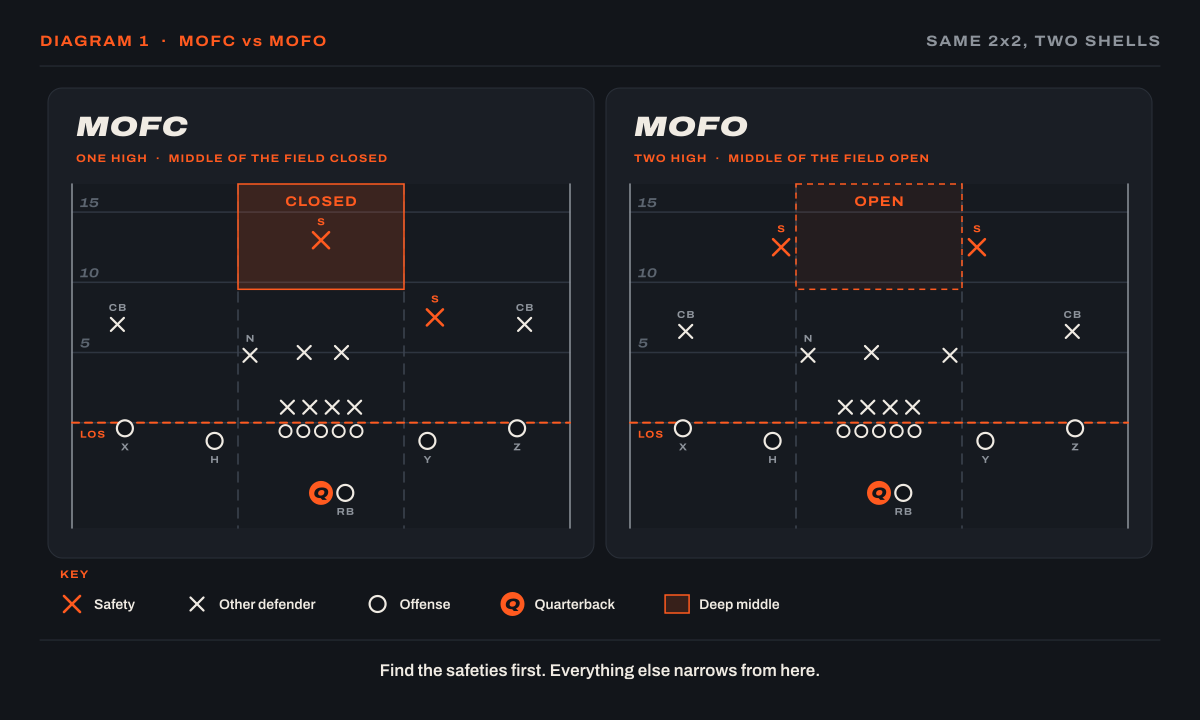
MOFC means "middle of the field closed." There's one safety deep in the middle, so you'll also hear it called a one-high or single-high look. MOFO means "middle of the field open." There are two safeties deep, usually splitting the field, which leaves the deep middle open. You'll hear it called a two-high look or a two-high shell.
| Shell | What he sees | Common coverages in this family | What he checks next |
|---|---|---|---|
| MOFC (one high) | One safety deep in the middle of the field | Cover 1 (man free), Cover 3 (zone) | Corner depth, eyes and leverage to tell man from zone |
| MOFO (two high) | Two safeties deep, splitting the field | Cover 2, Cover 4 (quarters), Cover 6 (quarter-quarter-half) | Corner depth and the safeties' depth and width |
| Zero high | No safety deep | Cover 0 (man with no deep help) | Treat it as pressure: count the box and find the hot answer |
Use your own terms in practice. Plenty of programs say "one high" and "two high," "closed" and "open," or something else entirely. The words he uses in this drill should be the words he hears in the huddle.
What the shell tells you, and what it doesn't
The shell narrows the answer. It doesn't finish it. A one-high look tells your quarterback the deep middle is defended, but not whether the corners are in man or zone. A two-high look tells him the deep middle is open before the snap, but not whether it will still be open after it.
That's why the shell call is the first read, not the only read. Teach it as a starting point: "I see one high, so it's probably Cover 1 or Cover 3. Now the corners tell me which."
How to identify coverage pre-snap: depth and width tells
Once he's found the safeties, these tells help your quarterback sort the shell and spot when it isn't what it looks like.
- Safety depth. A safety who is deep and steady before the snap is usually where he's going to play. A safety who creeps down, or sits shallower than he normally does, may be rotating down into the box or the flat.
- Safety width. Two-high safeties usually sit near the hashes or wider. If two safeties are pinched tight toward the middle, one of them may be on his way to the middle at the snap.
- Corner depth and eyes. In a one-high look, corners playing off with their eyes in the backfield point toward Cover 3. Corners pressed or tight with their eyes on the receiver point toward Cover 1. Have him check depth, eyes and leverage together, not just one of them.
- Overhang players. Where the nickel or outside linebacker lines up tells him who's responsible for the flat, and whether a safety is likely to rotate down to help.
How deep is deep and how wide is wide? That depends on your opponent. Pull the numbers from their film, not from a textbook, and write them into your answer key.
How to identify Cover 3 pre-snap
Cover 3 is one of the most common looks a young quarterback will see, so it's worth teaching on its own. The usual picture: one high safety in the middle of the field, corners playing off with outside or head-up leverage and their eyes in the backfield, and a defender walked out over the slot or tight end to cover the flat.
The coaching point is the comparison. Same single-high safety, but corners tight with inside leverage and eyes on their man? Now he should be thinking Cover 1. The shell is the same. The corners are what change the answer, which is why box count and corner leverage are the next reads on the checklist.
Disguise and the late re-check
Good defenses know quarterbacks read the safeties, so they disguise the shell. The most common versions your quarterback will see:
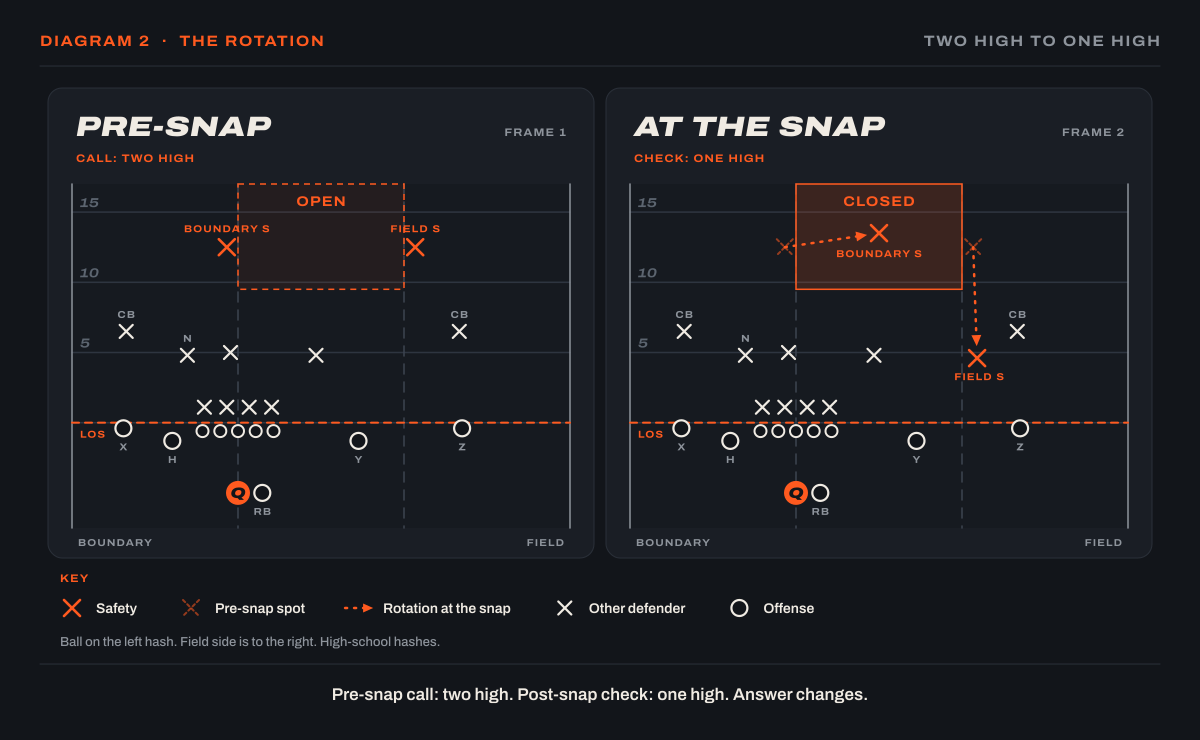
- Two high that rotates to one high. The defense shows two high, then one safety drives to the middle and the other comes down at the snap. It looks like Cover 2 or quarters before the snap and plays like Cover 3 or Cover 1 after it.
- One high that bails to two high. A safety starts down near the box, then backpedals to a deep half at the snap.
- Late movement. The safeties hold their pre-snap spots until the cadence starts, then shift.
The fix isn't to stop reading the safeties. It's to teach the pre-snap call as a hypothesis and the first steps of the drop as the check. Before the snap he says what he expects. As he drops, he looks for the safety in the middle of the field. If the picture matches, he trusts his answer. If it changed, he goes to the answer you've taught for the rotated look.
Seeing it from behind center
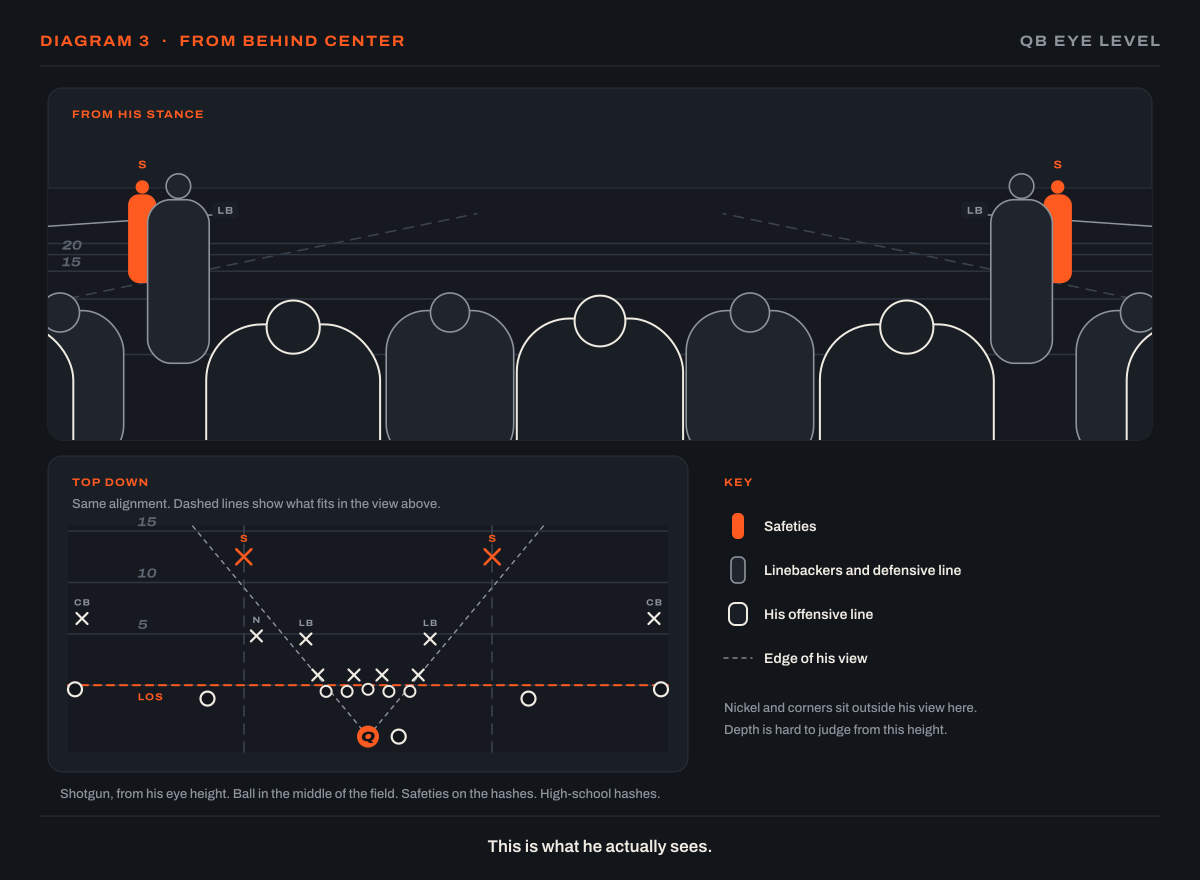
Most cheat sheets show the shell from the top down, like a whiteboard. Your quarterback never sees it that way. From behind center, his line, the linebackers and his own receivers block part of the picture, and depth is much harder to judge. A safety at 12 yards and one at 8 yards can look surprisingly similar from his stance.
That's the same reason film is hard to learn from: it's from a view he'll never play from. When you teach the shell, show both views. Draw it on the whiteboard first, then put him in his stance and have him find the safeties from there, with real people, cones or trash cans standing in at safety depth.
Install the habit: call the shell on every snap
The single best way to get your quarterback reading safeties is to make the shell call a habit, not a drill. Starting this week:
- Every snap, out loud. Before every snap in individual, walkthrough, 7-on-7 and team, he calls the shell: "one high," "two high," or "zero."
- Someone confirms it. A coach, the center or a backup quarterback says "yes" or "no." It takes a second and it keeps him honest.
- Re-check after the snap. After the rep, ask: "Did it stay that way?" That one question builds the post-snap check.
- Behind the play too. When he's not taking the rep, he stands behind the offense and makes the same call quietly, then checks himself against what happens.
Within a couple of weeks, the shell call should come before he's even set. When it does, you've freed up his eyes for the rest of the checklist.
The 10-look shell quiz
This drill needs one quarterback, one coach, and either a whiteboard or a laptop with opponent stills. It's the classroom version of the habit above, and it pairs well with the low-body drills in our guide to practicing QB reads without a full team.
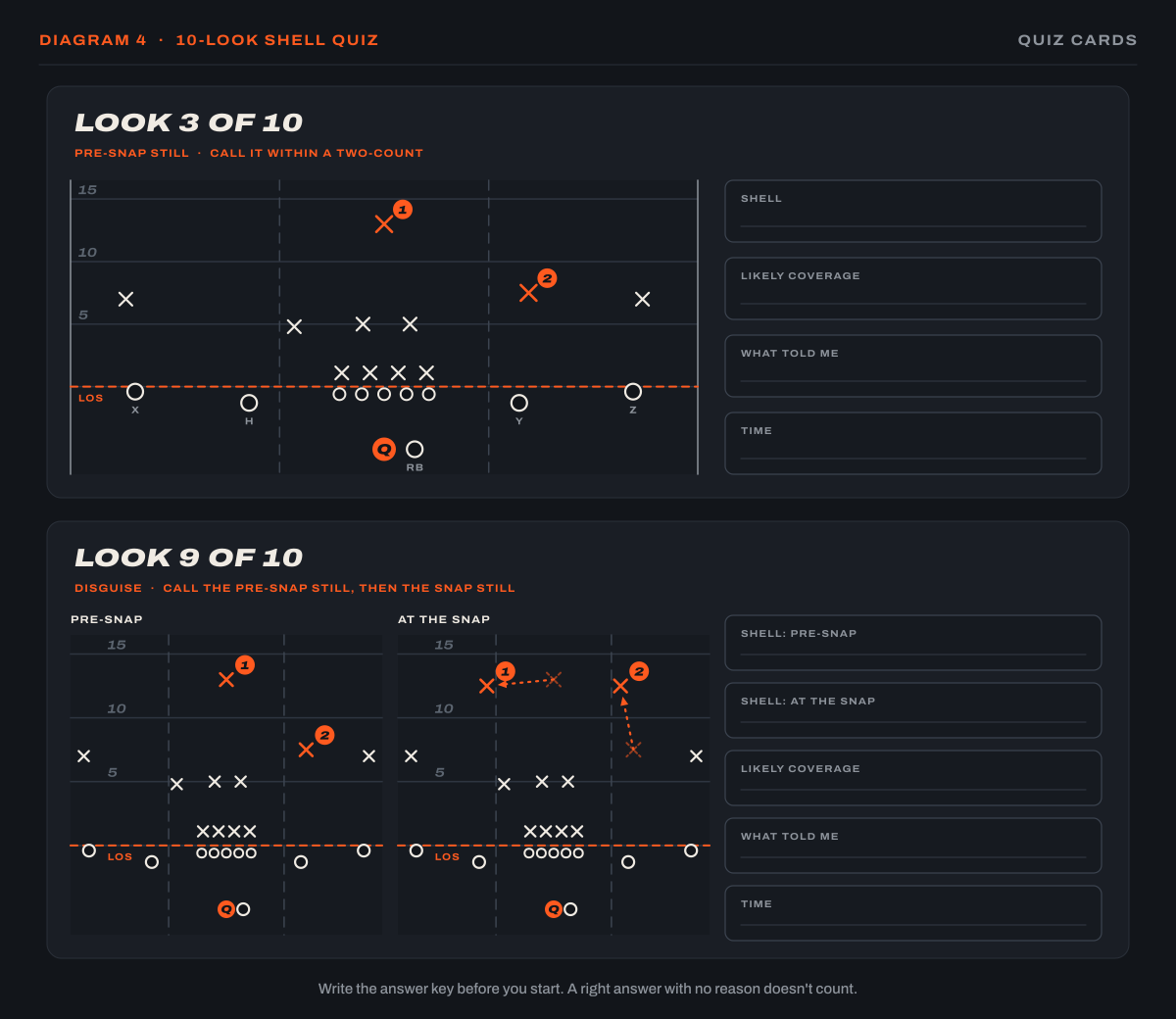
Setup: Pull 10 pre-snap pictures from your next opponent's film. Mix them on purpose:
- 4 one-high looks (some Cover 3, some Cover 1).
- 4 two-high looks (whatever split of Cover 2, quarters or Cover 6 your opponent plays).
- 2 disguises: a still from the snap that shows the shell changing.
Write the correct answer for each picture before you start. That's your answer key.
How to run it:
- Show a picture. The quarterback calls the shell within a two-count.
- He names the likely coverage family and the one thing that told him (for example: "One high, corners off with eyes in the backfield, so Cover 3").
- For the two disguise pictures, show the pre-snap still first, then the snap still. He calls both.
- Keep score on two things: correct calls and how quickly he made them.
Progression: Once he's getting 9 or 10 right without hesitating, move it outside. Use two trash cans at safety depth and move them between snaps, then rotate one at the snap, just like the trash-can safeties drill in Article 1. Same call, now from his stance.
Coaching point: A correct answer with no reason doesn't count. You want "one high, because...," not a lucky guess.
Common mistakes with young quarterbacks
- Reading the receiver first. If his eyes go to the route he likes before he finds the safeties, the shell call is coming too late. Make him find the safeties before he looks anywhere else.
- Stopping at the shell. "Two high" isn't an answer. Teach him to always name the next check.
- Trusting the pre-snap call no matter what. If the safety rotated, the picture changed. The post-snap check is part of the read.
- Using someone else's words. If the drill says "MOFO" and the huddle says "open," you're teaching two languages. Pick one.
Where TwoPointFive fits
We get it. You can't run every look in practice. The quiz and the habit above will get your quarterback calling the shell on every snap. But trash cans don't disguise, scout teams can't always show your opponent's exact rotations, and film is from a view he'll never play from.
That's the gap TwoPointFive was built for. TwoPointFive puts your quarterback behind center in realistic 3D, running your playbook against your opponent's actual defensive looks, and scores every rep so you can see what's sticking and what's not. It's pre-snap reps in 3D, from behind center. Built by Trevor and Kody in Utah County, alongside coaches.
Not ready for a demo? Start with the free Pre-Snap Checklist: the five reads every quarterback should own, starting with the safeties. Want to see it in the headset? Book a demo and ask anything.
FAQ
What do MOFO and MOFC mean in football?
MOFO stands for "middle of the field open": two safeties deep, splitting the field, with no one in the deep middle. MOFC stands for "middle of the field closed": one safety deep in the middle. They're the two coverage families a quarterback sorts the defense into before he reads anything else.
What coverages come from a two-high safety look?
The most common two-high coverages are Cover 2, Cover 4 (quarters) and Cover 6 (quarter-quarter-half). Defenses can also show two high and rotate to a one-high coverage at the snap, so the pre-snap call should always be checked after the snap.
How do you identify Cover 3 pre-snap?
Look for one high safety in the middle of the field, corners playing off with their eyes in the backfield, and a defender aligned over the slot or tight end to handle the flat. If the safety is the same but the corners are tight with their eyes on the receiver, think Cover 1 instead.
How do defenses disguise one high and two high?
The most common disguises are showing two high and rotating one safety to the middle at the snap, starting a safety near the box and bailing him to a deep half, and holding a look until the cadence starts. Teach the quarterback to make a pre-snap call, then confirm the safety in the middle of the field on his first steps of the drop.
When should a young quarterback learn to read safeties?
As early as he's taking snaps. Calling "one high" or "two high" doesn't require advanced knowledge, and it gives every other pre-snap read a starting point. Make it a habit before you add box count, corner leverage and pressure tells.