
QB READ DRILLS
How to Practice QB Reads Without a Full Team
Every coach knows the problem. Your quarterback needs to see a defense, decide, and deliver before he can trust what he sees on game day. But a full-speed read takes a field full of people: receivers, linebackers, corners, safeties, and a scout team that can actually show the look you want. Most weeks, you don't have that. Practice time is short, bodies are limited, and there's always another look to prepare for.
The good news is that a read is mostly a decision, and decisions can be repped with far fewer people than a team period. This guide gives you four QB read drills you can run with one quarterback and anywhere from zero to five helpers, a simple way to grade each read, and a weekly plan you can drop into your practice schedule.
Why reads are the hardest thing to rep
Throwing mechanics get reps every day. Footwork gets reps every day. Reads don't, because a read only exists when there's a defense to read. That leaves most programs with two options:
- Team and 7-on-7 periods. Realistic, but they cost a lot of bodies and practice minutes, and your quarterback might only see each look once or twice.
- Film. Easy to get, but it's from the end zone or the sideline, a view he'll never play from.
There's very little in between. The drills below fill that middle ground. None of them replace team periods. They make sure your quarterback walks into team periods already knowing what he's looking for.
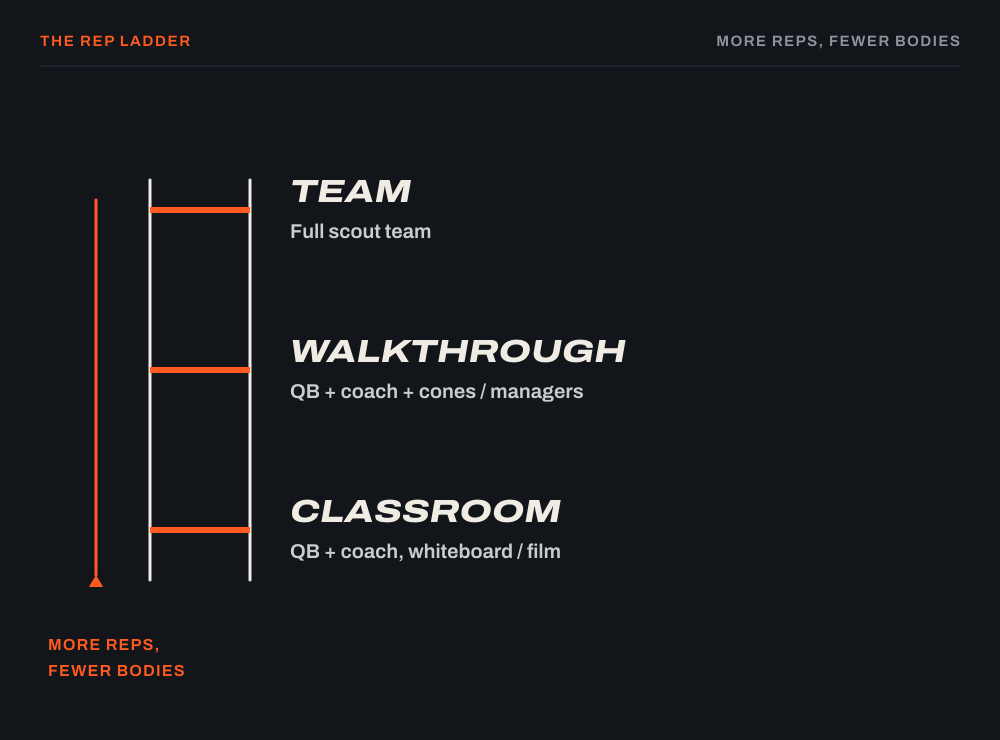
The rep ladder: classroom, walkthrough, team
Think of read development as a ladder. Each rung needs fewer people than the one above it, so you can run the lower rungs far more often.
- Classroom (0 extra players). Whiteboard and film. The quarterback learns to name what he sees.
- Walkthrough (1 coach, a few cones or managers). The quarterback sees the picture from behind center and makes the decision with his eyes and feet.
- Team (full scout team). Everything at speed, against people who move.
Most young quarterbacks get stuck because they jump from rung 1 straight to rung 3. The four drills below live on rungs 1 and 2.
4 QB read drills with few or no other players
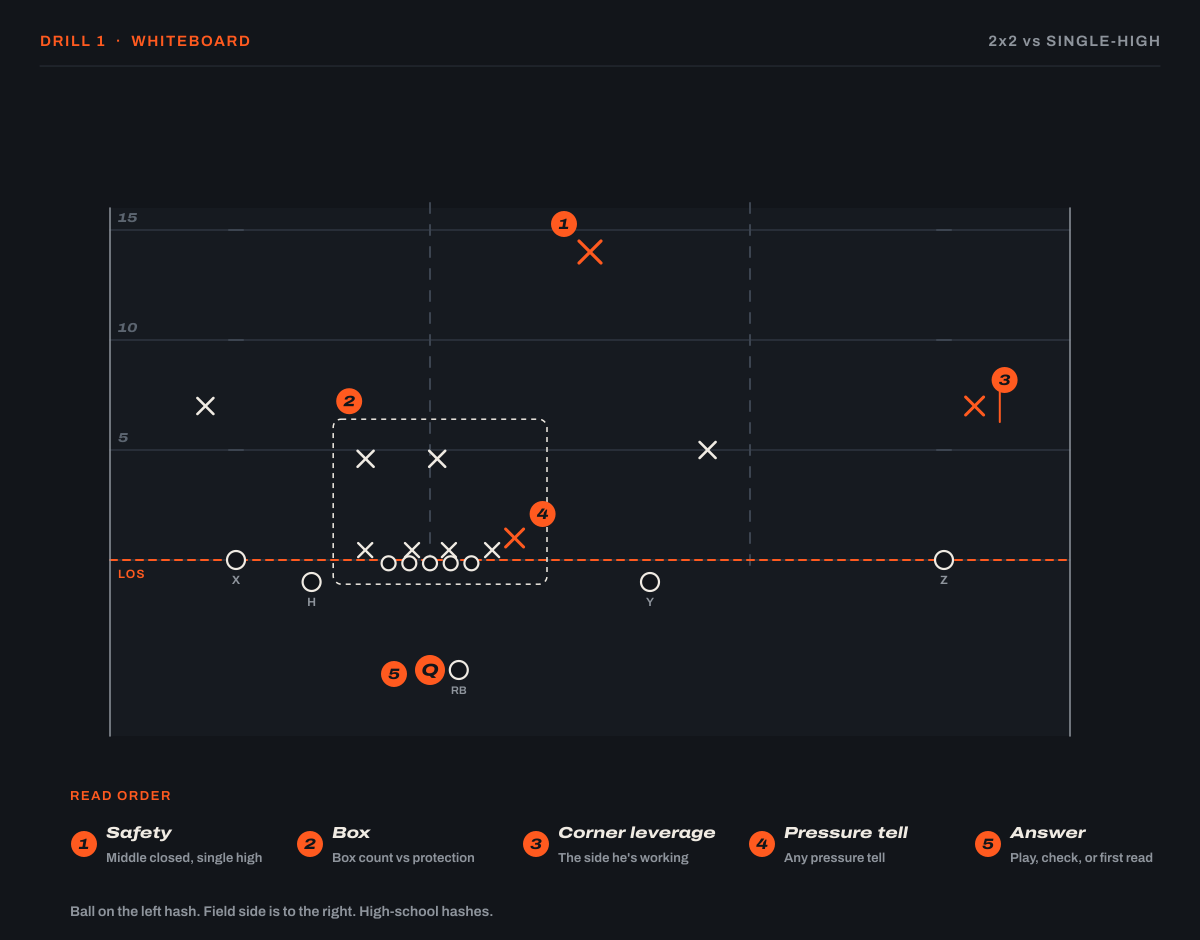
Each drill uses the same order of reads: safeties, box count, corner leverage, pressure tells, then the answer. If your quarterback uses that order every time, the drills stack on each other instead of feeling like four separate skills. Use your own terminology, not a textbook's. The words he hears in the drill should be the words he hears in the huddle.
Drill 1: The film-and-whiteboard quiz (0 extra players)
Who you need: One quarterback, one coach, a whiteboard or a laptop with opponent stills.
Setup: Draw or pull 8 to 10 defensive pre-snap pictures from your next opponent. Paused frames from opponent film work well. Mix the shells: single-high and two-high, a few pressure looks, and at least one disguise.
How to run it: Show a picture. The quarterback calls out, in order:
- The shell ("Middle of the field closed, single high").
- The box count against your protection.
- The corner leverage to the side he's working.
- Any pressure tell.
- His answer: the play, the check, or where the ball is going first.
Then show the next picture. Keep it moving. The goal is fast, confident naming, not a lecture on each frame.
Coaching point: If he gets the answer right but skips a step, it doesn't count. You're building a habit, not a guess.
Drill 2: Trash-can safeties (1 coach, 2 cones)
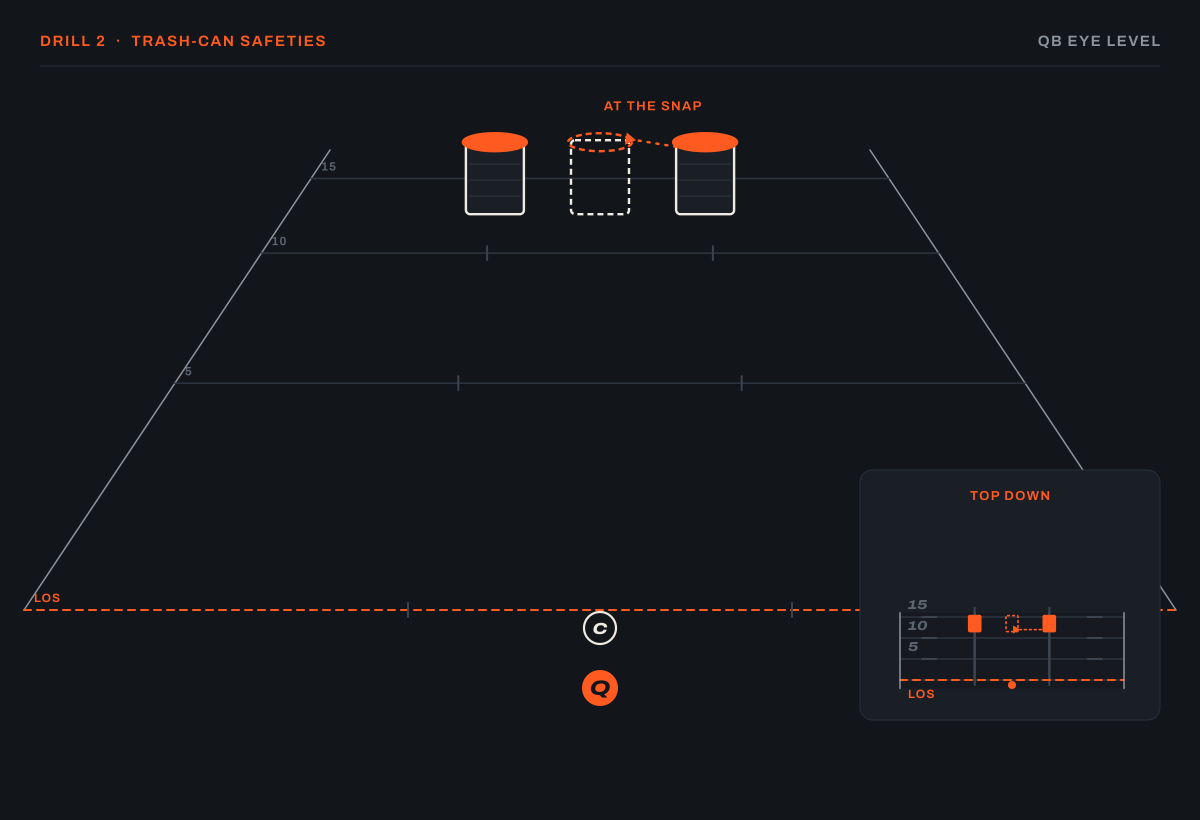
Who you need: One quarterback, one coach, two trash cans or tall cones, and a throwing net or target on each side of the field.
Setup: Place the two "safeties" at safety depth. The coach stands behind them so he can move them between snaps.
How to run it:
- The coach sets the cans in a two-high picture or rolls one to the middle for a single-high picture.
- The quarterback calls the shell before the snap, takes his drop, and throws to the side of the field that matches the read you've installed for that concept.
- Progression: Once he's solid, add a post-snap change. The coach moves one can right at the snap to show a rotation. The quarterback has to confirm or adjust after the snap. This trains the core idea behind every pre-snap read: anticipate before the snap, then confirm or adjust after it.
Coaching point: Watch his eyes before the snap. If he's staring at the target he wants, the cans aren't doing their job. He should be looking at the safeties until the picture is clear.
Drill 3: Coach as the conflict defender (1 coach, 1 to 2 targets)
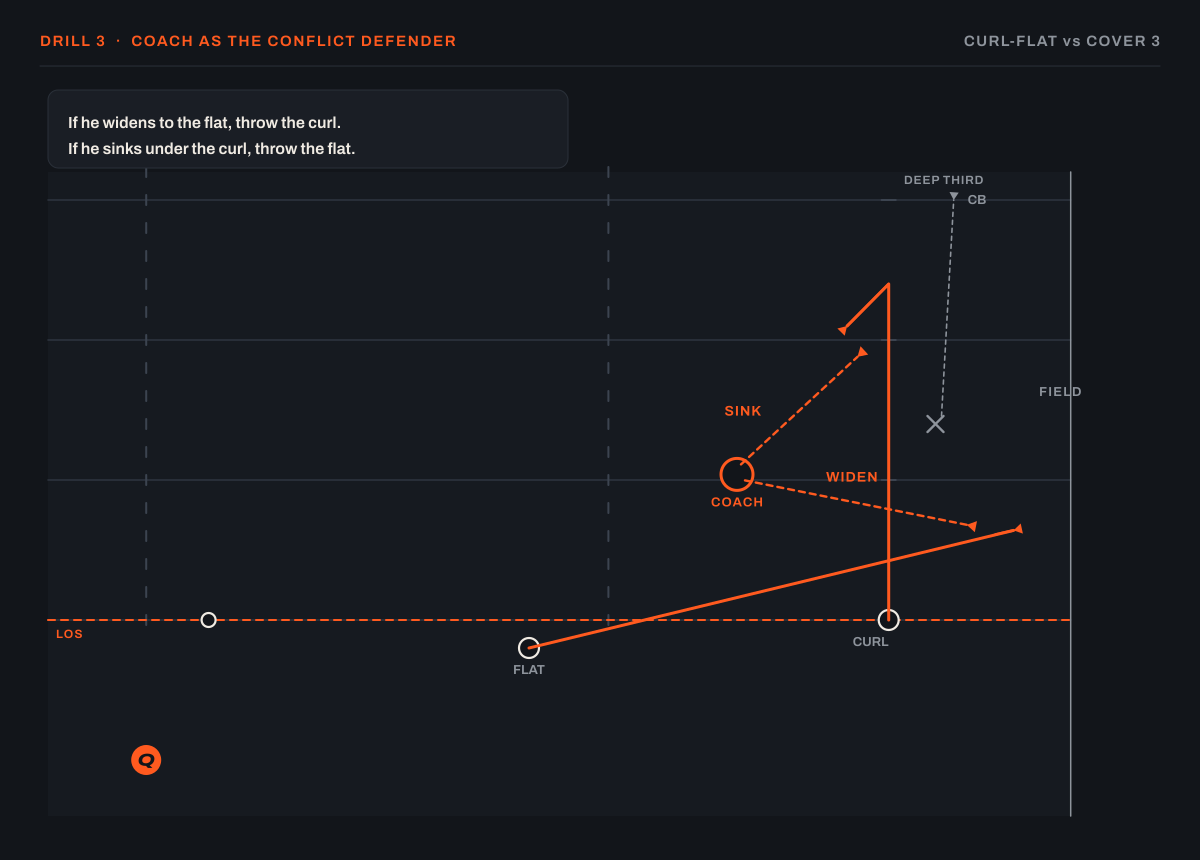
Who you need: One quarterback, one coach playing defense, and two targets (managers, receivers, or nets) set at the depths of a high-low concept.
Setup: Pick one concept where a single defender decides the throw. A curl-flat concept against a Cover 3 flat defender is a good starting point: the curl is the high throw and the flat is the low throw.
How to run it:
- The coach aligns as that defender. At the snap, he either widens to the flat or sinks under the curl.
- If he widens, the quarterback throws the curl. If he sinks, the quarterback throws the flat.
- Mix in pre-snap tells. Have the coach cheat his alignment or eyes on some reps so the quarterback learns to anticipate, not just react.
Coaching point: The read is the defender, not the receiver. Grade "where were his eyes at the top of the drop," not just "was it complete."
Drill 4: Scout-card air reads (3 to 5 managers or JV players)
Who you need: One quarterback, a coach, and three to five managers or JV players to stand in as defenders. Receivers are optional.
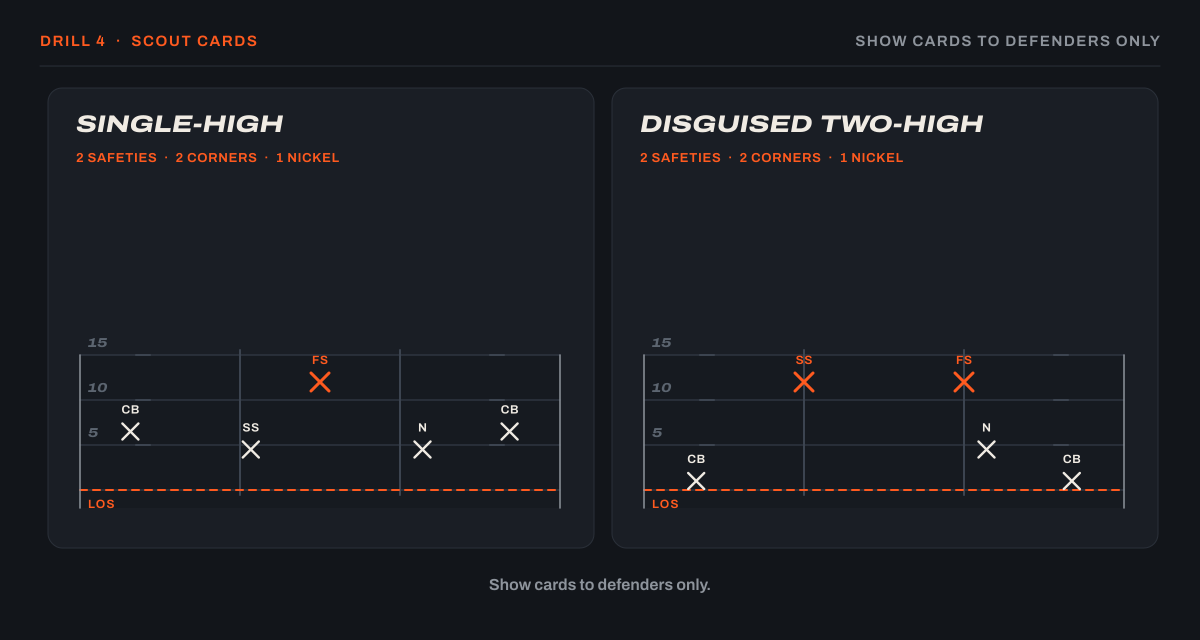
Setup: Build scout cards for your opponent's most common looks. Show the card to the defenders only. The quarterback doesn't know what's coming.
How to run it:
- Defenders align to the card. The quarterback works through his read order before the snap.
- At the snap, the defenders move to their coverage landmarks at walk or jog speed.
- The quarterback takes his drop and throws on air to the spot dictated by the look. If you have receivers, they run the concept. If not, he throws to a cone at the landmark.
Coaching point: Rotate the cards in a random order. A quarterback who sees the same look three times in a row is memorizing the drill, not reading the defense.
Add progression calls to every rep
Mental reps count when they're specific. On every rep in Drills 2 to 4, have your quarterback say his progression out loud as his eyes move: "One, two, check." When he's standing behind a teammate in team periods, he does the same thing quietly: call the shell, name the answer, then check himself against what actually happens.
Spoken progressions do two things. They force him to commit before the ball is thrown, and they let you hear the moment his read goes wrong. A missed throw tells you that something went wrong. A missed call tells you why.
How to grade a read objectively
"Throw it to the open guy" can't be graded. To make these drills worth the time, grade every rep against an answer you decided ahead of time.
- Write the answer down first. For each look in your drill, decide the correct shell call and the correct throw or check before practice. That's your answer key.
- Grade the decision and the speed separately. Was the call right? How long did it take? A right answer that's too slow is still a problem on game day, and it's a different problem from a wrong answer.
- Grade the cue, not the result. Ask, "What did you see?" If he names the right defender and the right movement, the read was good, even if the throw was off.
- Track misses by type. If most of his misses are against disguised shells, you know what to put on the whiteboard next week.
A weekly plan template
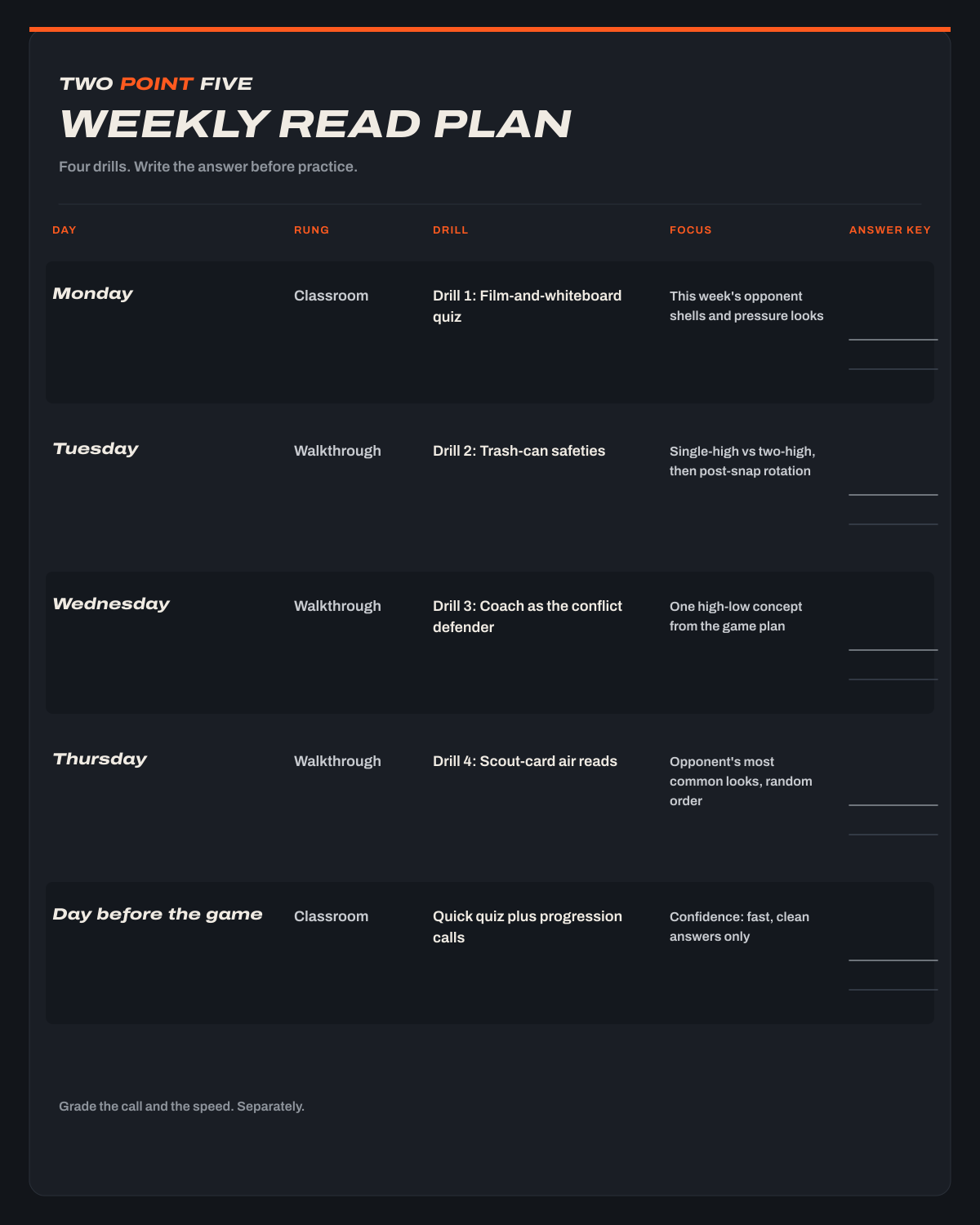
Use this as a starting point and adjust it to your practice schedule.
| Day | Rung | Drill | Focus |
|---|---|---|---|
| Monday | Classroom | Drill 1: Film-and-whiteboard quiz | This week's opponent shells and pressure looks |
| Tuesday | Walkthrough | Drill 2: Trash-can safeties | Single-high vs two-high, then post-snap rotation |
| Wednesday | Walkthrough | Drill 3: Coach as the conflict defender | One high-low concept from the game plan |
| Thursday | Walkthrough | Drill 4: Scout-card air reads | Opponent's most common looks, random order |
| Day before the game | Classroom | Quick quiz plus progression calls | Confidence: fast, clean answers only |
The gap these drills still leave
We get it. You can't run every look in practice. These drills will get your quarterback far more decisions per week than team periods alone. But even the best walkthrough has limits. Trash cans don't disguise. Managers can't show your opponent's exact looks at game speed. And film is still from a view he'll never play from.
That's the gap TwoPointFive was built for. TwoPointFive puts your quarterback behind center in realistic 3D, running your playbook against your opponent's actual defensive looks, and scores every rep so you can see what's sticking and what's not. It's pre-snap reps in 3D, from behind center. Built by Trevor and Kody in Utah County, alongside coaches.
Not ready for a demo? Start with the free Pre-Snap Checklist: the five reads every quarterback should own, the same read order used in the drills above. Want to see it in the headset? Book a demo and ask anything.
FAQ
How can a quarterback practice reads without a full team?
Break reads into rungs that need fewer people. Use film and whiteboard quizzes to build the vocabulary, cones or trash cans to show safety pictures from behind center, a coach as the single defender in a high-low concept, and managers on scout cards for walkthrough-speed looks. Save full team periods for putting it all together at speed.
What is the best QB read drill for beginners?
Start with a film-and-whiteboard quiz where the quarterback names the safety shell first on every picture. It needs no extra players, and identifying single-high versus two-high is the foundation for most other pre-snap reads.
Do mental reps actually help a quarterback?
Mental reps help most when they're specific. Have the quarterback call the shell and his answer out loud before each snap, then check himself against what happens. Grading those calls against a written answer key turns watching into practice.
How do you grade a quarterback's reads?
Decide the correct answer for each look before practice. Then grade each rep on two things separately: whether the call was correct and how quickly he made it. Ask what he saw, so you're grading the cue and not just whether the throw was complete.
How often should a quarterback work on reads?
As often as you can fit it in. Low-body drills like the ones above are designed to fit into short blocks of individual or walkthrough time most days of the week, instead of waiting for team periods.